
Artificial intelligence is rapidly becoming part of modern healthcare, with the World Health Organization (WHO) and numerous research institutions recognizing its growing role in diagnostics, risk assessment, and patient monitoring. Combined with wearable technology and biomarker tracking, AI-powered systems are changing how individuals understand and manage their health long before symptoms appear.
The trend reflects a broader shift toward data-driven preventive care. Organizations across the healthcare sector are exploring ways to integrate continuous health monitoring into clinical decision-making. Examples include clinics and longevity-focused practices such as GoodGeneMedical, which represent part of a growing movement that uses advanced health data, biomarker analysis, and personalized assessments to inform patient care. As healthcare technology evolves, AI and biomarker tracking are increasingly viewed as tools that may help individuals make more informed decisions about their long-term health.
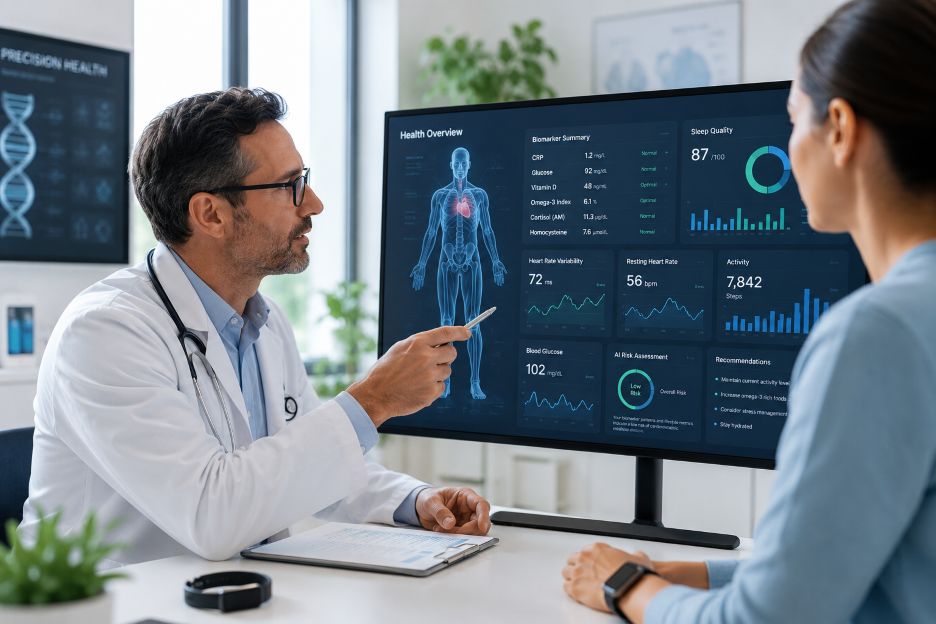
Artificial Intelligence Expands Its Role in Healthcare
Healthcare systems generate enormous volumes of information every day. Electronic health records, laboratory results, imaging studies, genetic data, and wearable device readings create datasets that are often too large for manual analysis alone.
Artificial intelligence offers a way to identify patterns within that information. Research published by The Lancet Digital Health and studies supported by the National Institutes of Health (NIH) suggest that AI models can assist clinicians by detecting trends, identifying risk factors, and supporting diagnostic processes.
Rather than replacing healthcare professionals, most current applications focus on augmenting clinical judgment. AI tools can help prioritize information, flag unusual results, and provide predictive insights that may otherwise be difficult to identify through traditional review methods.
Data indicates that healthcare providers are increasingly adopting these technologies as computing power improves and digital health infrastructure becomes more accessible. This trend is contributing to a new model of healthcare that emphasizes earlier detection and continuous monitoring.
Wearable Devices Generate a Constant Stream of Health Data
The rise of wearable technology has significantly expanded the amount of personal health information available outside clinical settings.
Smartwatches, fitness trackers, continuous glucose monitors, and other connected devices can collect data throughout the day. Common measurements include:
- Heart rate and heart rate variability
- Physical activity levels
- Sleep duration and sleep quality
- Blood oxygen saturation
- Body temperature trends
- Glucose fluctuations
Research from the American Heart Association suggests that wearable technologies can help individuals better understand lifestyle factors that influence cardiovascular health. Meanwhile, studies published in journals such as Nature Medicine indicate that continuous monitoring may reveal subtle physiological changes before a person notices symptoms.
These devices create a more detailed picture of daily health patterns than traditional annual examinations. Instead of relying on occasional measurements, users and healthcare providers can observe trends developing over weeks, months, or even years.
The Growing Importance of Biomarker Monitoring
Biomarkers are measurable indicators that provide information about biological processes within the body. Examples include cholesterol levels, blood glucose, inflammatory markers, hormone levels, and various metabolic measurements.
Historically, biomarker testing occurred primarily during routine medical visits. Advances in laboratory science and digital health platforms have expanded access to more comprehensive testing.
Experts from the Mayo Clinic note that biomarkers can help evaluate disease risk, monitor treatment effectiveness, and provide insights into overall physiological function. When combined with AI-driven analysis, these measurements may reveal patterns that individual test results alone cannot fully explain.
For example, a single cholesterol reading offers a snapshot of cardiovascular risk. Repeated measurements combined with data on sleep, exercise, diet, and genetics can provide a more complete understanding of how health status changes over time.
This broader perspective is driving interest in longitudinal health tracking, where individuals monitor trends rather than focusing solely on isolated results.
Predictive Analytics and Personalized Health Optimization
One of the most discussed developments in AI-assisted healthcare is predictive analytics.
Predictive models use historical and real-time information to estimate the likelihood of future outcomes. In healthcare, these systems may identify elevated risks for conditions such as cardiovascular disease, diabetes, or certain metabolic disorders.
Research supported by the Centers for Disease Control and Prevention (CDC) and the NIH highlights the potential value of early risk identification. Detecting emerging trends before disease develops may create opportunities for lifestyle interventions and preventive care.
Healthcare professionals are increasingly using predictive tools to support personalized recommendations. These recommendations can include adjustments to nutrition, physical activity, sleep habits, or follow-up testing schedules.
The goal is not necessarily to predict every future health event. Rather, predictive analytics aims to improve understanding of risk factors and help guide informed decisions.
Opportunities Created by Technology-Assisted Health Management
Several factors explain why AI and biomarker tracking continue to attract attention from healthcare organizations, researchers, and patients.
- Earlier Detection: Continuous monitoring may reveal changes before symptoms become noticeable.
- Personalization: Recommendations can be tailored to an individual’s unique health profile.
- Improved Engagement: Real-time feedback may encourage healthier lifestyle choices.
- Data Integration: Multiple health indicators can be analyzed together rather than separately.
- Population Insights: Large datasets help researchers identify broader health trends.
Research shows that patient engagement often improves when individuals have greater visibility into their own health metrics. Access to understandable data may encourage more active participation in preventive health strategies.
Limitations and Ongoing Challenges
Despite significant progress, AI-assisted health management faces important limitations.
Data quality remains a major concern. Wearable devices vary in accuracy, and measurements collected outside clinical settings may not always meet medical-grade standards. Researchers from Harvard Medical School and other academic institutions have emphasized the need for ongoing validation of consumer health technologies.
Privacy and security considerations also remain central issues. Large volumes of personal health information require strong safeguards to protect sensitive data.
Another challenge involves interpretation. Biomarkers and wearable metrics can provide useful information, but they rarely tell the complete story on their own. Clinical expertise remains essential for placing health data within the appropriate medical context.
Experts caution that technology should complement professional healthcare guidance rather than replace it. Human oversight continues to play a critical role in diagnosis, treatment planning, and patient communication.
Future Developments on the Horizon
The next generation of health technology is expected to combine artificial intelligence, advanced biomarkers, genomic information, and increasingly sophisticated sensors.
Researchers at institutions including Stanford Medicine, MIT, and the NIH are exploring systems capable of integrating multiple streams of health information into unified platforms. Future tools may provide more accurate risk assessments, enhanced disease monitoring, and increasingly personalized recommendations.
Advances in remote monitoring may also expand healthcare access by allowing clinicians to track patients outside traditional medical settings. As sensor technology becomes more sophisticated, the range of measurable biomarkers is likely to grow.
At the same time, regulators, healthcare organizations, and technology developers will continue addressing questions related to accuracy, transparency, ethics, and data governance.
READ ALSO: Access To Your Health Information There’s An App For That
Conclusion
Artificial intelligence and biomarker tracking are reshaping personal health management by transforming how health information is collected, analyzed, and applied. Wearable devices, predictive analytics, and comprehensive biomarker monitoring are contributing to a healthcare environment that increasingly emphasizes prevention, personalization, and continuous assessment.
While challenges involving accuracy, privacy, and interpretation remain, research suggests that technology-assisted health optimization will continue expanding across healthcare systems. As digital tools become more sophisticated, individuals and healthcare providers may gain deeper insights into long-term health trends, helping support more informed and proactive approaches to personal well-being.